Marmalead tutorial · Etsy listing research
How to Use the New Marmalead: Research and Write an Etsy Listing
Your product is ready. Your listing should be, too. Use Marmalead's keyword research, Customer Voice and Marma to choose accurate phrases, answer a buyer's question and build a title, tags and description you can review and use.
Affiliate disclosure: SellerToolsHQ may earn a commission if you purchase through a link in this guide, at no extra cost to you.
Product walkthrough checked October 12, 2026. Screenshots show the live website; the demonstration product is fictional.
One SEO tool. Your complete listing workflow.
Start with the listing you keep putting off. This guide uses Marmalead throughout: research phrases, understand buyer-review themes and ask Marma for a complete title, tags and description. You do not need another SEO tool to follow this workflow.
- Find the words
- Compare relevant phrases with keyword data and sampled products.
- Understand the question
- Read buyer-review themes and the source reviews behind them.
- Draft the listing
- Ask Marma for a title, tags and description grounded in your facts.
You review the wording and make the final change in Etsy.
Bring your next listing to the new MarmaleadProduct access requires a paid plan. Check current pricing and availability.
1. Choose one listing and one question
Start with something you actually sell or intend to make. Ask what you need to decide: how to describe it, which phrase fits, or what a buyer still needs to know.
If an existing listing has few visits, investigate its language and whether the offer matches the shoppers it reaches. If it gets visits but few orders, also inspect the photos, quantity, price and delivery details. Rewriting tags alone may leave the buyer's real question unanswered.
The fictional example used in this guide
One handmade ceramic mug. Twelve-ounce capacity. Blue glaze. Sold individually. Care compatibility, origin, shipping dates and personalization are unknown.
This is a demonstration brief, not a customer case study. We used the live website to research its phrases and run the writer prompt below. No Etsy listing was saved or published, and no sales result is claimed.
For your own listing, write down its verified facts first. A physical item needs details such as material, dimensions and quantity. A digital product needs its format, what the buyer receives, compatibility and what is editable.
2. Research phrases that truthfully describe the product
In Marmalead Search, enter a phrase you would use to describe the item. Look at the search, engagement and competition signals alongside the products shown. A large number is less useful if the phrase mostly brings up a different product.
For the fictional mug, reasonable starting phrases are ceramic mug, blue ceramic mug and handmade mug. They describe supplied facts. “Personalized mug set” does not.
- Inspect the sampled products. Are they comparable in material, quantity and use?
- Read the period and labels attached to the metrics.
- Use related searches to discover alternatives, then check that they still fit.
- Compare two accurate phrases side by side in Compare.
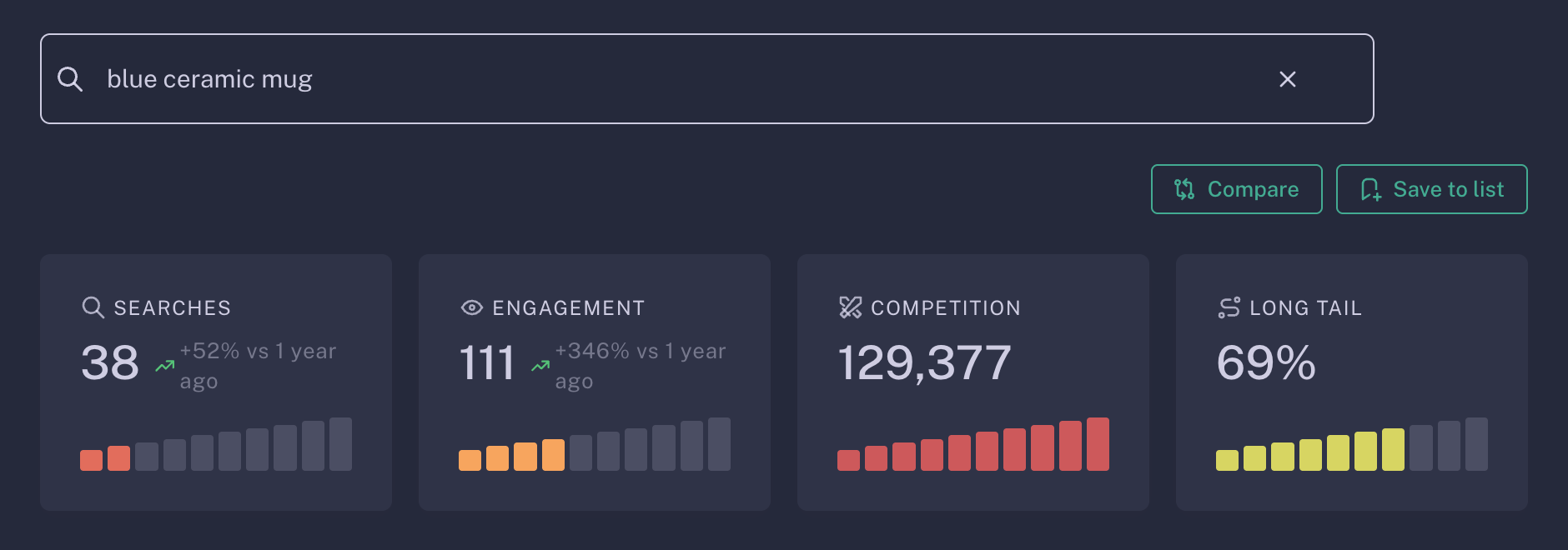
In our result, blue ceramic mug showed 38 Searches, 111 Engagement and 129,377 Competition. The sampled products included individual mugs and sets. That is a useful reason to inspect the items behind a phrase: the words match our product, but not every competing offer sells the same quantity. Keep the accurate phrase and make 12 oz, sold individually clear in the listing.

Compare made the tradeoff visible: ceramic mug had much higher Searches (91,559 versus 38), alongside much higher Competition (1,439,457 versus 129,383). The narrower phrase adds our product's actual color. Neither row proves which wording will convert; use the comparison to choose relevant language, not to promise a ranking or pick a winner from one number.
You can also ask Marma to compare phrases and explain the tradeoff. After supplying the fictional product facts in the conversation, try this:
For that fictional mug, compare ceramic mug, blue ceramic mug, and handmade mug using Marmalead keyword data. Explain which phrase fits the product and what the numbers do and do not tell me.
Judge the answer against the item you are selling. Forecasts describe a keyword market; they are not a prediction of your listing's visits or orders. You do not need to choose the biggest phrase just because it is bigger.
Keep a short list with a reason beside each phrase. Marmalead Keyword Lists can preserve your shortlist; keeping your own decision notes is useful too.
3. Find a buyer question worth answering
On a relevant keyword result, open Customer Voice and select Analyze Reviews. It groups themes from sampled reviews and lets you inspect their source text. Look for a question that matters to the item you are offering, then read the underlying reviews before using the theme.
These are reviews from a market sample, not necessarily reviews from your own shop. A theme is a research lead. It does not prove every buyer shares that concern.
Our actual analysis for blue ceramic mug returned a size-and-function theme. We expanded its 19 source reviews: buyers mentioned the size they wanted for lattes and large coffees, and whether the item matched its description. That gives us a concrete question to answer: how much does this mug hold?
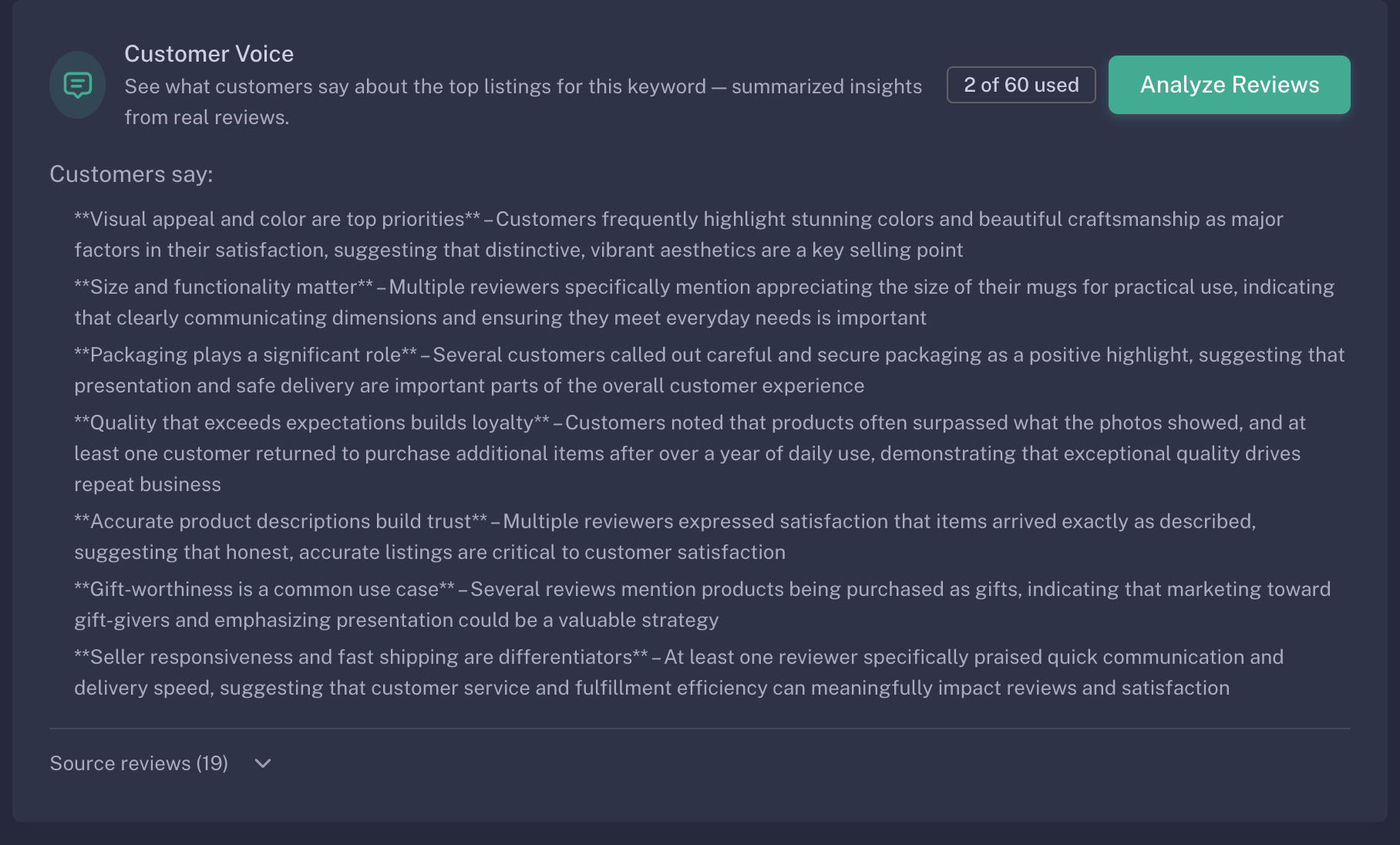
For our fictional brief, the answer is 12 oz. Put that verified capacity where a buyer can find it. The reviews do not establish that our mug is durable, dishwasher safe or carefully packaged; those would need our own facts.
Carry the actual concern and the relevant product facts into Marma. For example: “The reviews I checked raised [actual concern]. My product's verified detail is [fact]. Help me explain that clearly.” Avoid borrowing another seller's claims, description or photos.
4. Ask Marma for a complete listing draft
Give Marma the product facts and tell it what wording you need. If you are working on an existing listing, supply its link or identifier so the question points to the right item. Do not assume a listing name alone identifies every item in a large shop.
Rewriting an existing description? Paste the whole description, including the care and delivery details you want to keep, even when using the extension. Save a copy of your old wording before making changes.
For the fictional product, this is the writer prompt:
Use this fictional product only, not my connected shop. A handmade ceramic mug, 12 oz, blue glaze, sold individually. I do not know whether it is dishwasher or microwave safe. Write a clear Etsy title and 13 comma-separated tags, each no longer than 20 characters. Then draft a short description. Do not invent care, shipping, origin or personalization facts.
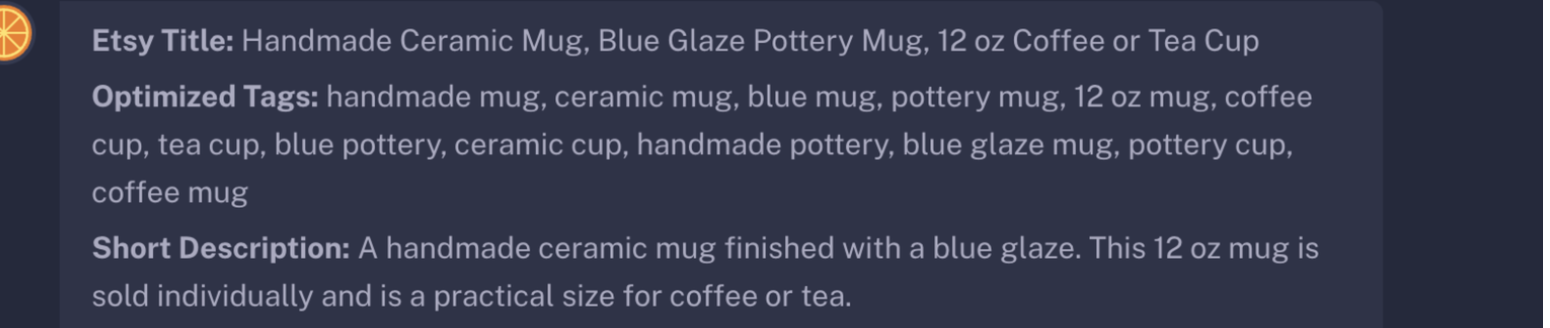
Read the actual draft as text
Title: Handmade Ceramic Mug, Blue Glaze Pottery Mug, 12 oz Coffee or Tea Cup
Tags: handmade mug, ceramic mug, blue mug, pottery mug, 12 oz mug, coffee cup, tea cup, blue pottery, ceramic cup, handmade pottery, blue glaze mug, pottery cup, coffee mug
Description: A handmade ceramic mug finished with a blue glaze. This 12 oz mug is sold individually and is a practical size for coffee or tea.
In this response, all 13 tags were distinct and 20 characters or fewer. The wording kept the blue glaze, 12 oz capacity and individual quantity, and omitted the unknown care, shipping, origin and personalization details. That is a useful draft to review. It does not make every tag the best choice for your product or guarantee that another response will be accurate.
Adapt the facts when you use your own product. Ask for the complete title, tags and description, then read all three. If the response omits a requested part or adds an unsupported detail, ask for a correction before using it.
You can follow up in the same conversation: ask why a phrase was included, clarify the quantity, or explain a limitation. Paste any research findings that matter to the decision; do not assume every website report is automatically present in chat.
See what a clearer listing explains
Fictional editorial illustration, written for this guide. These lines are not a Marma response or a researched keyword recommendation.
- A title that piles up words
- Beautiful Mug Gift Coffee Tea Ceramic Handmade
- A title that explains the item
- Blue Ceramic Mug, 12 oz, Handmade, Sold Individually
- An opening that answers what arrives
- This listing is for one handmade ceramic mug with a blue glaze and 12 oz capacity.
The clearer lines name the item, capacity and quantity using the supplied facts. Actual phrase research helps you decide which wording deserves space in your own listing. Care and shipping details still need your verified input.
Try the workflow with one of your products
Bring its facts, one wording question and any research you want Marma to consider.
Research and draft your next listing with Marmalead5. Review the draft and choose what to use
A useful draft still needs your judgment. Check these details before changing Etsy:
- Product truth: material, size, quantity, format and compatibility match what you sell.
- Promises: care, origin, delivery and personalization are supported by your facts.
- Clarity: the title and opening description explain what the buyer receives.
- Tags: the requested pack is complete, each tag fits the twenty-character limit, and the phrases describe your item.
- Your decision: you can say why you kept, edited or rejected a suggestion.
You can keep accurate existing wording. A Marmalead grade is a diagnostic, not Etsy's ranking score, and a different score alone is not evidence of a better offer.
Make the approved change in Etsy yourself. If you use compatible Chrome extension Apply controls, review the fields they fill and complete Etsy's save step. Controls and supported context depend on the installed version. This workflow can be completed using the website and a manual copy-and-review handoff.
Keep a note of what changed and why. For an existing listing, record its dated Etsy Stats before the change and revisit a comparable period afterward. Note other changes such as photos, prices or promotions. A change in visits or orders does not by itself establish that one keyword edit caused it.
Keep a decision note you can reuse
Fill in these five lines for the wording you choose. Reopen the note when you research your next variation or revisit the listing.
- Phrase considered: What wording are you comparing?
- Evidence checked: Which metric, sampled product or source review informed you?
- Product fit: Which verified fact makes the phrase accurate?
- Wording kept: What line will you use or edit?
- Why: What buyer question does that choice answer?
Your first-session checklist
- Choose one product and write its known facts.
- Inspect and compare two accurate buyer phrases.
- Check one relevant Customer Voice theme and its source reviews, if available.
- Ask Marma for the wording you need, with those facts and findings.
- Review the complete draft and choose one useful next step.
Finish with a complete draft you have checked and a wording choice you can explain. Keep the research and reasoning so the next listing starts with what you learned.
Questions before you start
What is the difference between Marmalead and Marma?
Marmalead is the research and listing-help product. Marma is its conversational assistant. Website tools such as Search, Compare and Customer Voice let you inspect evidence; Marma helps with questions and drafts. Carry relevant findings into the conversation rather than assuming every screen shares its context automatically.
Does Marma change my Etsy listing for me?
Marma provides wording for you to review. You decide what to use and save it in Etsy. Compatible extension Apply controls can fill editor fields, but filling a field is not saving or publishing a listing.
Do keyword forecasts predict my sales?
No. They estimate activity around a keyword market. They do not predict visits, orders or profit for your particular listing. Product fit, photos, the offer and other factors still matter.
Should I change keywords if I have visits but no orders?
First inspect what shoppers are seeing: the item, photos, quantity, price, delivery information and unanswered questions. Keyword research can help explain whether the traffic fits your product, but a lack of orders does not by itself establish a keyword problem.
Put your next listing to work.
Bring the product you already know to Marmalead. Find relevant words, check a buyer question and ask Marma for a complete draft. Review it, make your choice and save the wording you want in Etsy.
View Marmalead plansPaid product. Check current access, pricing and terms before subscribing.